
How Much Does Corporate Event Catering Cost San Diego?

Corporate event catering cost in San Diego depends on the guest count, menu, service style, event schedule, and venue needs; there is no single rate that fits every gathering. For a broader look at planning a business event, see Corporate Event Catering Packages.
In brief: Start by defining the experience, headcount, timing, and service level you need. Then compare proposals by what each includes, not by a single per-person figure, and ask the caterer to explain staffing, setup, service, and venue-related costs.
What Shapes a Corporate Event Catering Cost San Diego Estimate?
The quote reflects the work behind the meal as well as the food itself. Guest count, menu choices, service format, event duration, staffing, and access at the venue all shape the plan.
Two corporate events with the same number of guests can call for very different catering plans. A short meeting with a simple meal has different needs from an evening reception with passed appetizers, stations, and a staffed bar service arranged by the client or venue. In San Diego, a downtown conference room, a coastal space in La Jolla, and an outdoor gathering in Rancho Santa Fe may also have different access and setup requirements.
There is no fixed public rate for Gather by Oren. Each proposal is developed around the event brief, scale, and venue factors. The best starting point is a clear outline of the guest experience you want, rather than choosing a menu before the logistics are known.
- Guest count:
The number of attendees affects food quantities, staffing, equipment planning, and how service moves through the room.
- Menu and ingredients:
A customized seasonal menu may include different courses, proteins, sides, and dietary accommodations. Local availability and the level of menu detail matter.
- Service style:
Plated dinners, family-style meals, grazing tables, interactive stations, and passed appetizers each require a different setup and service plan.
- Labor and timing:
The event schedule, length of service, room turnover, and preparation window influence the team needed on site.
- Venue logistics:
Load-in access, kitchen availability, room layout, parking, service distance, and setup or breakdown windows can affect what the event requires.
- Special requests:
Cultural considerations, dietary needs, presentation details, and a specific event flow should be discussed early so they can be planned accurately.
For corporate events, confirm allergen details early. FDA guidance on food allergen labeling explains that ingredient and allergen information helps people with food allergies avoid ingredients to which they may react.
These factors work together. For example, a reception with a short program may benefit from passed bites that let guests mingle. A leadership dinner in Del Mar may call for a seated format with coordinated courses. Neither format is automatically more suitable; the event purpose and guest experience should guide the choice. Consider how the event will feel from a guest's point of view. If people arrive in waves after a conference session, service may need to remain available beyond one fixed seating. If an executive program has a precise start and end, a meal plan with defined service timing may be easier to coordinate. A short conversation about the schedule can prevent choosing a format that looks attractive on paper but does not fit the room or program.
How Do Guest Count and Service Level Affect Corporate Event Catering Cost San Diego?
Guest count helps determine quantities and staffing, while service style determines how food is prepared, presented, and served. Consider both together when you compare options.
Headcount is a planning input, not a complete budget. A larger guest list can increase food volume and staff needs, but the service format and menu also matter. A smaller executive dinner may involve more individual plating and synchronized service, while a larger company gathering might use stations or a reception format to keep guests moving comfortably.
Think about the event's purpose before selecting a style. Is the meal the main program, or is it supporting a presentation or networking session? Do guests need to arrive and eat within a short break? Will participants be seated, standing, or moving between rooms? Answers to these questions help a chef recommend a practical service plan.
Service format. | Often suits. | Planning points to confirm. |
Plated dinner. | Seated dinners, recognition events, and formal programs. | Final guest count, seating plan, meal timing, dietary requests, and coordinated service. |
Family-style meal. | Team gatherings where shared dishes support a relaxed, connected table. | Table layout, serving space, dietary needs, and how dishes will reach each table. |
Grazing table or stations. | Networking events and receptions where guests circulate. | Room flow, station placement, replenishment, event duration, and access for all guests. |
Passed appetizers. | Receptions, launches, and short social periods before a program. | Guest arrival pattern, service duration, number and variety of bites, and staff movement. |
Buffet service. | Casual or flexible meal periods where guests choose from a shared line. | Line placement, pacing, menu labeling needs, replenishment, and accessibility. |
Use the comparison as a conversation starter, not as a fixed cost chart.
A format can be adapted to the room and program.
For instance, an event at a downtown San Diego office may need a service plan that respects a narrow lunch break, while a coastal reception may allow a longer window for guests to mingle.
Ask the caterer how the proposed style fits the schedule and space. For example, a room with limited circulation space may need a different station layout than a wide reception area. A venue with a strict load-in window may also call for a more detailed setup sequence. Share floor plans or venue notes if you have them, and flag any restrictions that could affect service. Those practical details help turn a general preference into a workable recommendation for the actual event. For a San Diego event, weather and the setting may influence whether a plan belongs indoors or outside, and the venue's own service rules may shape the room layout. Ask who will confirm these details and when. Do not treat an outdoor setting, a kitchen, or a specific load-in arrangement as guaranteed. Verify the conditions with the venue and share any changes with the catering team.
Gather by Oren creates customized menus rather than relying on a single preset option. Chef Oren Koreh is directly involved in menu curation, and the menu can reflect the occasion, the host's preferences, dietary and cultural needs, venue, and season. Explore Seasonal Custom Menus to see the menu approach, then discuss what suits your company event.
What Is Included in Full-Service Corporate Catering vs. Drop-Off?
Full-service catering coordinates more than the food: it can include menu design, professional staffing, setup, service, and breakdown. A drop-off arrangement is a different scope, so compare the exact responsibilities in writing.
When reviewing a proposal, check who owns each part of the event-day plan. The label "full service" is only useful when you know what it covers for your event. Gather by Oren describes its full-service model as food, service, venue coordination, and plating, with professional staff scaled to the event and setup, service, and breakdown included in the overall execution.
Venue coordination does not mean the caterer owns the venue. It means the planning team can coordinate relevant catering details with the venue, such as access, timing, layout, and service requirements. This distinction is important when you are planning at a hotel, office, or event space in Coronado, La Jolla, or elsewhere in San Diego County.
- Menu planning:
Confirm how menu choices are developed and when the final selections and guest count are due.
- Staffing:
Ask which event-day roles are part of the proposal and how service is planned for your guest count and format.
- Setup and breakdown:
Clarify what the team will set up, when it can access the space, and what it will remove or reset afterward.
- Venue communication:
Confirm who will coordinate catering details with the venue and what information the venue must provide.
- Food presentation and service:
Make sure the proposal reflects your preferred style, from plated courses to stations or passed bites.
- Items outside the scope:
Ask directly about any service or event need that is not described, so responsibilities are clear before approval.
For some occasions, the right fit may be a focused meal service; for others, a coordinated team makes the event easier to manage. The choice should account for what your internal team can handle. If your staff would otherwise need to arrange setup, manage food service, and coordinate cleanup during a client event, include that workload in the comparison.
Also distinguish between what the caterer manages and what remains with your company or venue contact. If your office team will welcome guests, manage room changes, or handle presentation equipment, note those roles separately. Clear ownership prevents a rushed handoff on the event day and helps you understand whether the service plan matches your team's capacity. This is particularly useful for events spread across more than one room or with a transition from a meeting into a reception.
Gather by Oren serves corporate meetings, launches, and conferences, along with weddings, B Mitzvah celebrations, and private gatherings. Its corporate event details are available on the Corporate Event Catering Packages page. You can also learn about the chef-led approach on the San Diego Caterer | Chef Oren Koreh page.
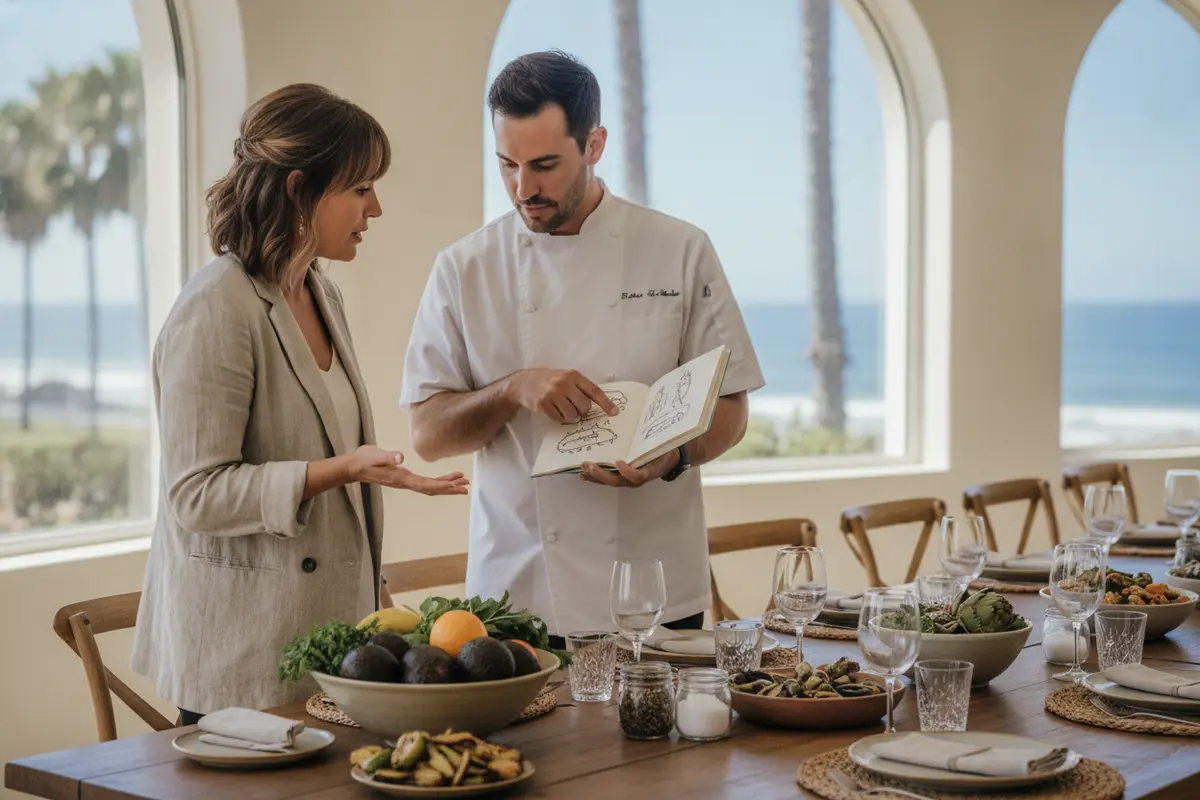
How Can You Compare Catering Proposals Fairly in San Diego?
Compare proposals against the same event brief and scope. Look at the menu, staffing, schedule, venue responsibilities, and what is excluded before judging the overall value.
A quick comparison of headline totals can hide important differences. One proposal may include staff and breakdown, while another may cover food delivery only. One may account for a long reception and a complicated load-in, while another may assume a straightforward room setup. Ask each prospective caterer to respond to the same core information.
- Write one shared brief.
Include the date, location, purpose, estimated attendance, event schedule, and the type of guest experience you want.
- Describe the food and service goals.
Share meal timing, preferred style, cuisine direction, known dietary needs, and any cultural considerations.
- List venue conditions.
Note the room, kitchen access if known, load-in instructions, available setup window, and any venue rules you already have.
- Ask for a clear scope.
Request detail on menu, staffing, setup, service, breakdown, coordination, and any assumptions or exclusions.
- Compare like with like.
Check whether proposals use the same headcount, duration, service format, and menu expectations before weighing the totals.
- Resolve open questions.
Confirm deadlines, payment schedule, final count process, and how changes to the event plan will be handled.
Also consider how well the proposed experience fits your business and guests. For a product announcement in downtown San Diego, food may need to support a tightly timed presentation and informal conversations. A team celebration in Rancho Santa Fe may call for a more leisurely meal with a different level of service. The right proposal makes those details understandable rather than leaving you to infer them.
If you need a useful menu reference, Gather by Oren offers its Coastal California menu. This can help you describe flavors and direction, but it is not a fixed package or a substitute for a tailored event proposal. Menus can be shaped around season, preferences, event format, and practical venue needs.
When comparing terms, do not assume that a line item or service is included unless the proposal says so. Request clarification on any unfamiliar charge or responsibility, and keep the final scope in one written document.
That makes it easier for your internal team, venue, and caterer to work from the same plan. Use a short comparison worksheet to check each proposal against the shared brief:
- Event basics:
Confirm the stated guest count, location, date, and service duration.
- Food and service:
Compare the menu direction, service format, staffing, and presentation details.
- Venue responsibilities:
Review setup, breakdown, access, coordination, and any exclusions.
- Open questions:
Mark unanswered items rather than filling in assumptions.
If an event detail changes, such as the room, schedule, or attendance, ask whether the proposal should be updated so all providers are responding to the same version of the plan. It can also help to separate essential requests from optional enhancements. Identify the parts of the experience that matter most to your guests, then ask how menu or service choices could support those priorities. This gives you a more useful discussion than removing details at random, since changes to one part of the service may affect staffing or timing elsewhere.
How Do You Request a Corporate Event Catering Cost San Diego Quote?
A useful quote request gives the caterer enough detail to shape a realistic plan, while making clear which event details are still tentative.
You do not need to have every menu decision made before you start a conversation. Provide the information you know, identify what is still being decided, and describe the outcome you want. A chef can then help connect the food, service format, and logistics to the event.
- Date and location:
Share the event date or date range, venue name if selected, and neighborhood or city.
- Attendance:
Give an estimated headcount and say whether it may change.
- Schedule:
Outline guest arrival, presentation or program time, meal or reception period, and finish.
- Event purpose:
Explain whether it is a client meeting, team celebration, conference, launch, or another gathering.
- Experience and menu direction:
Describe the service style, food preferences, and any dietary or cultural requirements you know about.
- Venue logistics:
Include room access, kitchen details, restrictions, setup window, and venue contact information if available.
- Decision timeline:
Note when you need to review options and when the event plan must be confirmed.
Gather by Oren is based in San Diego and serves San Diego County and Southern California. Chef Oren Koreh brings international culinary experience and Mediterranean and Middle Eastern expertise to a personalized process, with menus shaped around each client's vision and the season. For a company gathering, that can mean discussing California citrus, local avocados, seasonal seafood, or another direction suited to the occasion and menu plan.
Once the details are shared, ask what information is needed to refine the proposal, what the quote includes, and what remains open. Gather by Oren provides consultation-based quotes because event requirements differ.
That approach avoids treating a specific menu, headcount, venue, or service plan as if it were universal. If some facts are unknown, label them as estimates rather than waiting to reach out. A preliminary inquiry can identify which decisions matter most and what details the venue still needs to confirm. It can also help your planning group agree on priorities, such as a seated meal, a seasonal menu, or enough service time for guests to connect. Keeping those priorities visible makes later revisions more focused and helps the final scope reflect the experience you intend to host.
Frequently Asked Questions
Can I get a corporate catering price before choosing a menu?
You can begin a conversation with an estimated headcount, date, venue, schedule, and service preferences. A personalized quote will depend on the event's scope, and the menu can be refined with Chef Oren as details are discussed.
Why can two events with the same guest count have different quotes?
Guest count is only one part of the plan. Menus, service styles, event duration, staffing, venue access, and setup needs can vary, changing the work required for each event.
Does full-service catering include venue rental?
No. Gather by Oren coordinates with venues but does not own event venues. Ask the venue directly about rental terms, and confirm with the caterer which catering logistics and services are covered in the proposal.
When should I request a quote?
Reach out when you have a likely date, location, and approximate guest count, even if some choices are not final. Sharing the decision timeline helps the caterer explain what can be planned now and what details can follow.
Can Gather by Oren accommodate dietary and cultural needs?
Menus can be adapted to dietary and cultural requirements. Share known needs early so they can be considered during menu planning and reflected clearly in the event plan.
A clear brief is the best first step toward a corporate event meal that fits your guests, schedule, and San Diego venue.



Comments