
Downtown San Diego Corporate Catering: Office Event Options in the Business District

Downtown San Diego corporate catering needs to work around more than a menu. Office schedules, guest flow, building access, room setup, and the purpose of the gathering all shape the right plan. For a broader view of planning a company event, start with Gather by Oren’s guide to corporate event catering.
In short, successful office-event catering in downtown San Diego starts with the room, schedule, and guest experience, not just the food. Set the service style and timing first, confirm building and delivery details with the venue or office contact, then shape a customized menu around the event and guests. Full-service support can also cover staffing, setup, service, and breakdown.
Why Is Downtown San Diego Corporate Catering Distinctive?
Downtown’s mix of offices, meeting spaces, and waterfront destinations makes flexibility essential: a compact working lunch and a hosted reception call for different service plans.
The business district brings together financial and professional services offices, company meeting rooms, and event settings near the waterfront. That range creates opportunity for many kinds of gatherings: a leadership lunch between appointments, an all-hands meeting, a client presentation, a training day, or an evening reception. Each has a different rhythm and a different level of formality.
Office events also happen inside spaces that were not necessarily designed as dining rooms. A conference table may need to remain available for laptops and papers. A shared room may need to be reset quickly for the next meeting. Guests may arrive in waves rather than sitting down together. These practical details determine whether food should be served in a separate area, placed at stations, passed during a reception, or brought to guests at a seated meal.
Downtown planners may also consider event locations beyond the office itself. The San Diego Maritime Museum’s corporate events page describes its setting as being in the heart of downtown, with customizable options and event coordination. That kind of venue can suit a different occasion than an office meeting, but it still calls for clear agreement on guest flow, schedule, service needs, and the role of the venue team. Gather works with venues rather than owning them, so responsibilities should be confirmed directly for each event.
- For a working meeting:
prioritize food that is easy to serve and enjoy without interrupting the agenda.
- For a client gathering:
align the menu and service style with the tone you want guests to experience.
- For a company celebration:
allow enough time and room for people to connect, not only collect a plate.
Downtown is part of a broader San Diego event landscape. A company may host one gathering near the central business district and another in La Jolla, Coronado, Del Mar, or Rancho Santa Fe. A consistent standard of hospitality can carry across locations, while the menu and logistics adapt to each setting.
What Do Downtown Offices Need from a Corporate Caterer?
A downtown office event runs more smoothly when one plan connects the menu, guest count, room layout, access instructions, and service timeline.
Before settling on dishes, identify what the meeting or event must accomplish. Is it important to keep the program moving? Will guests be networking? Are people arriving at different times? Does the host want a seated meal or a more open format? These answers help match service to the event instead of asking one menu to serve every situation.
Build a short event brief that includes the following:
- Purpose and schedule:
note the start time, program, breaks, and when guests can comfortably eat.
- Guest count:
share the best current estimate and when it can be confirmed.
- Room and service area:
clarify where food can be placed, where guests can gather, and what must remain clear.
- Building procedures:
ask the office or venue contact about loading access, check-in, delivery windows, elevators, and any requirements for outside vendors.
- Dietary and cultural needs:
collect requests early and explain them clearly so the menu can be considered as a whole.
- On-site roles:
determine who will direct the catering team and who can answer questions on the event day.
Do not assume that a caterer can use a loading area, service elevator, kitchen, or storage space. Those details vary by building and venue. Ask the person responsible for the space, then pass the confirmed information to the catering team. A simple arrival plan can prevent last-minute confusion: where to check in, which entrance to use, who to call, and how much time is available to set up.
Good planning also respects the office’s working day. For a lunch with a short break, establish a service window and choose a format that avoids a long queue. For an executive or client meal, allow a more deliberate pace and coordinate service with the agenda. For a reception, plan where guests will move and gather so food and conversation can share the room comfortably.
Gather by Oren approaches catering as a full-service experience that can include menu design, professional staffing, setup, service, and breakdown. The appropriate scope depends on the event. Some hosts need staff to guide the flow throughout the gathering; others may need a more focused level of support. Discuss the room, schedule, and responsibilities together rather than assuming that every event needs the same arrangement.
How Does Full-Service Catering Work in a Downtown High-Rise?
Full-service catering links preparation to on-site execution: the team plans the menu and staffing, confirms access and timing, then sets up, serves, and clears the event according to the agreed scope.
In a high-rise, the route from arrival to the event room matters. A delivery window may be limited, check-in may take time, and lifts or corridors may be shared. The host can help by confirming the building’s procedures before the event and sharing them in one clear set of instructions. Include a day-of contact who will be reachable when the team arrives.
A practical sequence can look like this:
- Discuss the event:
share the occasion, guest range, location, timing, service preference, and priorities.
- Shape the menu and service plan:
consider the season, guest needs, room setup, and pace of the program.
- Confirm scope and responsibilities:
agree on staffing, setup, service, breakdown, and any venue coordination included in the plan.
- Verify access:
have the office or venue contact confirm entry, delivery timing, loading instructions, and room availability.
- Review the final details:
reconfirm the guest count, schedule, menu, dietary needs, point of contact, and any changes before the event.
Use the final review to resolve small questions while there is still time. For example, if a presentation ends at noon and lunch begins immediately, ask whether the room can be set before guests arrive or whether a nearby area is better suited to service. If the meeting must continue during lunch, discuss a format that allows guests to eat without making the room difficult to use.
Role clarity matters just as much as timing. The host or venue contact can share building rules and access instructions. The catering team can explain what it will bring, how it will serve, and what its agreed responsibilities cover. A venue may have its own requirements, too. A direct conversation among the relevant contacts helps keep everyone aligned without asking the office planner to relay changing information repeatedly.
Gather’s catering services can be tailored to the event, and the team coordinates with venues rather than presenting a venue as its own. If your event is at an external downtown location, confirm the venue’s rules and any separate venue responsibilities as part of planning.
Which Menu Styles Suit Downtown San Diego Office Events?
The best menu is the one that fits the event’s timing, room, and guests; seasonal ingredients and a customized menu let hosts create an experience that feels considered rather than generic.
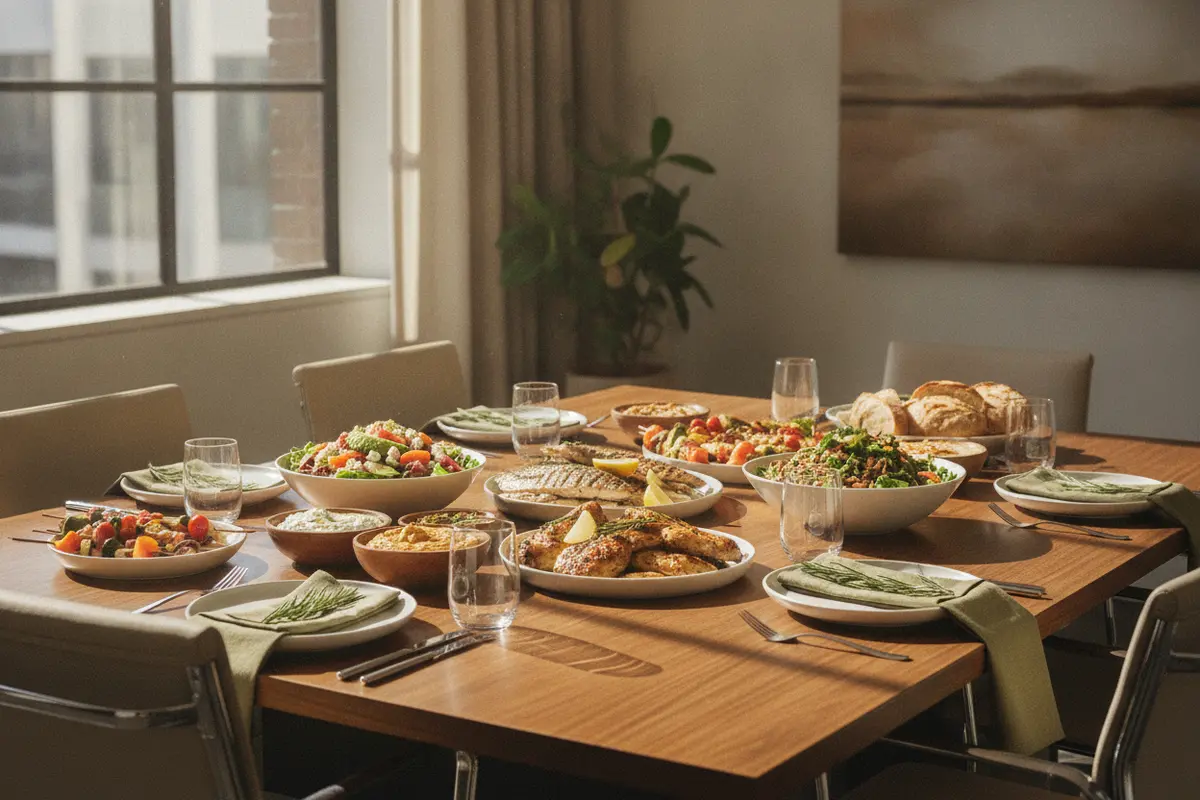
San Diego’s food culture gives planners room to bring a sense of place to a company gathering. A menu may take inspiration from Mediterranean and Middle Eastern flavors, California citrus, local avocados, seasonal vegetables, or seafood when appropriate. The specific choices should follow the season, guest preferences, dietary requirements, and the kind of occasion, not a fixed formula.
Gather by Oren builds custom menus with Chef Oren Koreh directly involved in menu curation. That allows the host to discuss the event’s vision, tastes, cultural considerations, and practical needs together. A gathering near the waterfront may call for a different mood than a morning leadership meeting or a celebratory evening reception, even when both are downtown.
Use the format comparison below as a starting point. It is not a fixed package list; the right menu and service plan are determined through a conversation about the event.
Event format | When it can fit | Planning considerations |
Seated meal | Leadership lunches, hosted client meals, or a formal program | Confirm seating, meal timing, service pace, and any agenda transitions. |
Family-style service | Team gatherings where sharing food is part of the experience | Check table space, guest needs, and how dishes will be passed and replenished. |
Reception with passed bites | Networking, launches, and evening events with guests moving around | Plan the event duration, circulation space, and staffing for service. |
Interactive stations | Company celebrations or events where guests can choose at their own pace | Allow space for stations and consider guest flow and queue management. |
Working lunch setup | Training sessions or meetings with a defined break | Make access easy, protect meeting materials, and keep the break on schedule. |
Each style has trade-offs. A seated meal offers a clear shared moment but requires the room and schedule to support it. Passed bites can keep a reception social, though the host should consider how long guests will be standing and moving. Stations encourage choice, but their placement and guest flow need attention. A working lunch can protect the agenda, provided service is designed around the room instead of blocking it.
For examples of how a menu can vary by occasion, browse Gather’s seasonal custom menus and corporate menu options. They can help you describe a direction, but your event menu should be discussed and customized rather than treated as a set package.
Dietary needs deserve more than a last-minute note. Gather can adapt menus for dietary and cultural requirements, so share requests early and, when possible, provide clear details about the guests’ needs. Discuss how those dishes will be identified and served, too. That is particularly useful when attendees have different requirements or when the event has a tight program.
How Can You Book Downtown San Diego Corporate Catering?
To request a useful quote, send the event date, location, guest estimate, schedule, service preference, and known dietary needs; the catering plan can then be shaped around real requirements.
Start with the information you already have. You do not need every detail finalized to begin a conversation, but sharing a clear outline makes it easier to discuss realistic options. If some details are still in progress, identify them as open questions rather than guessing.
Event date, time, and downtown address or venue.
Occasion, agenda, and the time guests can eat.
Estimated attendance and expected date for a final guest count.
Preferred service style and the level of on-site assistance you may need.
Dietary, cultural, or other guest considerations.
Room details, building access instructions, and the venue or office contact.
Menu direction, such as Mediterranean-inspired flavors, seasonal California ingredients, or a particular celebration tone.
Pricing is customized to the event’s requirements, scale, and venue factors. Ask for a proposal that clearly describes the planned menu, staffing, setup, service, breakdown, and any coordination included. If your scope changes, discuss the effect before confirming changes so the host and team share the same understanding of what is included.
Gather serves events in San Diego County and Southern California. Its approach is personal and chef-led rather than based on one standard menu for every group. Hosts planning a wedding or family celebration elsewhere in the region can also review the company’s wedding catering and Bar and Bat Mitzvah catering pages to see other event services.
For a downtown event, the most productive first conversation is specific: what are you hosting, what should guests feel, and what must work in the room? With those answers, the team can discuss a menu and service plan that reflects the occasion and its practical limits.
Frequently Asked Questions
Can a menu be customized for a downtown office event?
Yes. Gather by Oren creates customized menus with Chef Oren Koreh involved in menu curation. The menu can be discussed around the occasion, season, guest preferences, dietary or cultural needs, and the office or venue setting.
What service styles can work for a business-district gathering?
Options can include a plated meal, family-style service, passed appetizers, interactive stations, or a working-lunch setup. The right fit depends on the agenda, room layout, guest flow, and how much time guests have to eat.
Does Gather by Oren own downtown event venues?
No. Gather by Oren provides catering and coordinates with venues; it does not own event venues. Hosts should confirm venue access, rules, and any separate venue services with the venue contact.
What information should I provide when requesting a quote?
Share the date, location, guest estimate, schedule, service preference, known dietary needs, and any building-access instructions you have. If some details are not final, explain what is still being decided.
Does full-service catering include setup and breakdown?
Full-service catering can include menu design, professional staffing, setup, service, and breakdown. Confirm the scope for your event in the proposal so everyone understands which responsibilities are included.
A well-planned downtown gathering gives people room to focus on the meeting, the celebration, and one another. Start with the experience you want to create, then build the menu and service plan around the people and place.
For your next office event, choose a plan that feels welcoming to guests and works smoothly within the downtown schedule.

Comments