
Booking Wedding Caterer Timeline San Diego: A Planning Guide
- Oren

- 3 days ago
- 8 min read
Booking a wedding caterer is not only a date decision. For San Diego couples, the most useful timeline connects each milestone to the next. Confirm the venue context and share a guest range. Then compare service scope, review a clear proposal, secure the date, and refine the menu.
The booking wedding caterer timeline san diego couples can use is a milestone plan from inquiry through contract and final logistics. Gather by Oren's stated ideal planning window is 3 to 6 months. But the right pace depends on the date, venue, guest count, service style, and how much customization the celebration requires.
This article focuses on what to decide and verify at each stage, rather than repeating a general lead-time guide. A coastal reception in La Jolla, a garden celebration in Rancho Santa Fe, and a formal event in Del Mar can require different conversations. Those conversations may cover access, staffing, menu flow, and service. For the broader picture, review the San Diego wedding catering guide.
Contact Us to share your date, venue, guest range, and culinary vision.
A Booking Wedding Caterer Timeline San Diego Couples Can Use
This timeline follows the decisions that move a wedding catering plan forward: inquiry, consultation, proposal, contract, menu refinement, and day-of coordination. It is a planning framework, not a universal deadline.
The broad lead-time question has its own existing Gather article. This page serves couples who want to understand what happens after they begin comparing caterers and how to keep each decision from arriving out of sequence.
- Early planning:
Confirm the date or date range, venue direction, estimated guest count, and the feeling you want guests to experience. A venue in Coronado, La Jolla, Del Mar, or Rancho Santa Fe may have different access rules and service spaces.
- First inquiry:
Send the details you know, including meal period, service style, dietary needs, cultural considerations, and any indoor-outdoor movement. You do not need final RSVPs or a finished menu to start a useful conversation.
- Consultation:
Discuss the event atmosphere, guest experience, venue characteristics, staffing, setup, service, breakdown, and menu direction. A chef-led consultation should make room for your vision rather than forcing a preset package.
- Proposal review:
Compare what each proposal actually includes. Look for staffing roles, venue coordination, rentals, service pacing, setup, cleanup, payment milestones, and any conditions that could change the scope.
- Booking:
Once the scope is clear, review the contract and deposit terms. Gather's process uses a non-refundable deposit to secure the date. The proposal and contract should align before you commit.
- Refinement:
Shape the menu around the season, venue, tastes, guest needs, and service style. A tasting, when applicable, can help you refine selections and how courses work together.
- Final coordination:
Confirm headcount, arrival and load-in, prep space, meal timing, venue contact, rentals, allergy details, and breakdown responsibilities. The goal is a service plan that feels calm on the wedding day.
Keep a shared planning record with the current guest estimate, venue requirements, approved menu direction, open questions, and the owner of each next decision. That simple habit is especially useful when several vendors are coordinating around a reception at a private estate or coastal property.
What Should Be Decided Before the First Catering Conversation?
Bring the details that are firm and label the rest as estimates. A date or date range, venue, guest range, meal timing, service style, and known dietary or cultural needs are enough to begin.
Start with the information that affects feasibility. If your reception is at a La Jolla home, a Del Mar coastal property, a Carmel Valley vineyard. Or a Rancho Santa Fe estate, share the setting and any venue access information you already have. If the venue is not selected, describe the kind of space you are considering. This helps the caterer ask better questions without pretending that the plan is final.
Date or date range and venue status.
Estimated guest range, rather than a final RSVP total.
Meal period and reception schedule.
Desired atmosphere and preferred service style.
Dietary, allergy, religious, and cultural requirements.
Venue access, prep, power, water, parking, and indoor-outdoor considerations.
Your first conversation should also establish how the caterer works. Ask who leads menu development, how the team coordinates with the venue, what professional staffing covers, and which responsibilities remain with the venue or other vendors. Gather by Oren's full-service model connects menu design with staffing, setup, service, plating, and breakdown. That is different from simply arranging food delivery.
It is also reasonable to ask how the proposal will be built. A useful discussion should connect your priorities to event scale, venue factors, service scope, and customization. For more questions to bring into the decision, read these questions to ask a wedding caterer.
Do not wait for every answer before opening the conversation. An honest estimate gives the caterer a starting point, while a clear list of unknowns prevents early assumptions from becoming expensive surprises later.
How Does a Chef-Led Menu Take Shape After Booking?
After booking, the menu develops through collaboration, seasonal ingredient choices, tasting and refinement, and alignment with the reception schedule. The final selections should feel connected to your story, venue, guests, and the way you want the meal to unfold.
Chef Oren's role begins with listening. The consultation can explore the celebration's atmosphere, personal tastes, cultural traditions, dietary needs, guest demographics, venue characteristics, and logistical requirements. A formal plated dinner at The Abbey on 5th calls for a distinct service rhythm. A family-style gathering at a private North County property may need a different plan. The menu is not a fixed package presented as the final answer.
Seasonality gives the planning conversation a useful point of reference. California citrus, local avocados, seasonal seafood, and other market ingredients can inform the menu as the wedding approaches. Mediterranean and Middle Eastern influences may also be shaped around the couple's preferences, rather than treated as a one-size-fits-all theme.
- Vision:
Define the mood, flavors, traditions, and guest experience you want to create.
- Service:
Match plated dining, family-style service, stations, or a cocktail format to the schedule and setting.
- Season:
Refine ingredients and preparations as the date and market availability become more specific.
- Guest needs:
Address allergies, dietary preferences, and cultural requirements early enough for thoughtful preparation.
A tasting, when applicable, lets you experience the selections and make informed adjustments. Discuss flavor balance, presentation, portion direction, course pacing, and how the menu works as a complete meal. You can explore seasonal custom wedding menus for inspiration, then use your own preferences to guide the conversation.
As the event gets closer, menu decisions should be confirmed alongside the guest count, venue access, staffing plan, and service timeline. This connection is important. A dish is not fully planned until the team knows how it will be prepared, held, served, and supported in the actual San Diego venue.
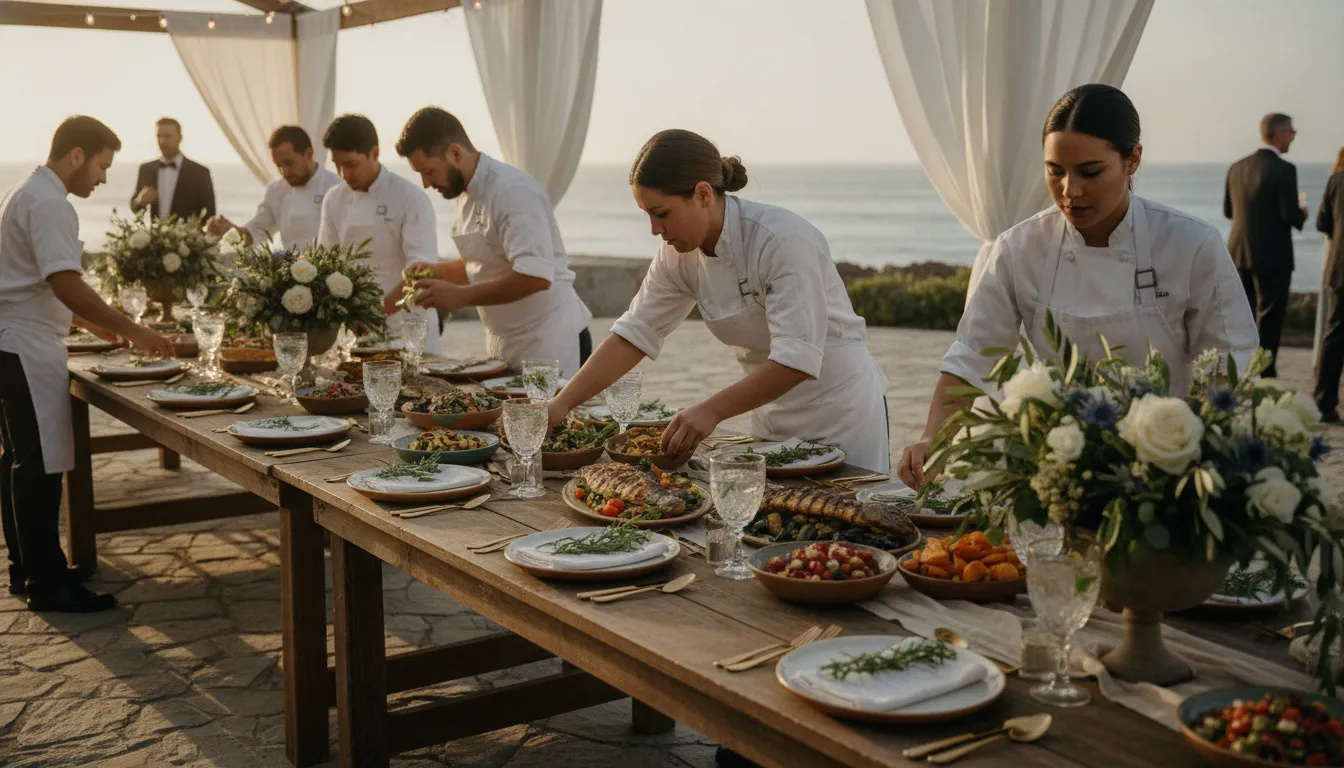
What Should a Wedding Catering Proposal Spell Out?
A strong proposal makes the service promise concrete. It should explain the menu direction, staffing, setup, service, breakdown, venue coordination, rentals, timing assumptions, payment milestones, and conditions that may change the scope.
Read the proposal as an operating plan, not only a menu description. A premium experience depends on details that are easy to miss. The food is often the most visible part of the document. Compare proposals using the same questions so you can see where the service models genuinely differ.
Proposal areaVerifyStaffingCount and roles.VenueAccess, prep, setup, service, cleanup, and breakdown.TimingMeal pacing and overtime triggers.ItemsRentals, add-ons, delivery, pickup, and event materials.
Ask for plain-language answers where the proposal is broad. "Service included" should be clarified into who sets tables, replenishes food, clears plates, handles trash, communicates with the venue. And restores the space. "Rentals available" should identify what is included and what is an add-on. "Additional charges may apply" should lead to a discussion of the specific trigger and how it is documented.
Does the written scope match what was discussed?
Which staff members are present, and who supervises the event?
What does setup, service, cleanup, and breakdown include?
Which venue requirements are known, and who confirms them?
When does a payment milestone or change in scope apply?
Gather's process moves from inquiry to consultation, customized proposal, deposit, contract, and ongoing refinement. The non-refundable deposit secures the date, so review the proposal and contract together before signing. A clear document protects the couple and gives the service team a reliable foundation.
Red Flags to Watch For When Evaluating Wedding Catering Proposals
Be cautious when a proposal hides service responsibilities, leaves venue logistics vague. Treats a standardized menu as fully customized, or uses unclear conditions to shift the scope after you commit.
A red flag is not a difference in style. It is a missing answer to a decision that affects your guests, your venue, or the team's ability to execute. Before signing, ask the caterer to clarify the following points in writing.
- Vague staffing:
The proposal does not identify the number of servers, their roles, or who supervises service on site.
- Unclear setup and breakdown:
It does not say who handles tables, food setup, bussing, trash removal, cleanup, rentals, or the end-of-night reset.
- Unmapped venue logistics:
There is no discussion of load-in, prep space, parking, power, water, kitchen access, guest flow, weather, or venue deadlines.
- Hidden add-ons:
Rentals, delivery, pickup, damage policies, staffing changes, or overtime appear only as vague "additional" items.
- Rigid menu claims:
A fixed menu is presented as customization even though it does not address the couple's tastes, cultural needs, season, venue, or dietary requirements.
- Pressure without clarity:
You are urged to sign or place a deposit before receiving a complete scope, payment schedule, or cancellation terms.
Food preparation and guest safety deserve direct questions too. USDA guidance recommends asking where food is prepared, how off-site food is transported, how it is stored until service, and how cross-contamination is prevented. Ask how allergy information is collected and communicated before the event. This is especially important when your guest list includes allergies, vegetarian or vegan preferences, or cultural requirements.
For an outdoor reception near Coronado or Point Loma, ask how the plan handles temperature, shade, wind, access, and service pacing. A San Diego County venue may have its own requirements, so confirm current rules with the venue team before signing. Gather coordinates with venues rather than owning them, and a thoughtful proposal should make that shared responsibility clear.
If the answers are specific, consistent, and reflected in the contract. You can compare the proposal on the quality of its plan instead of trying to decode a sales document. If answers remain unclear, pause and ask for a revised scope before moving to the next milestone.
Tell us your vision before you approve the final catering scope.
Frequently Asked Questions
What should I have ready before contacting a wedding caterer?
Share your date or date range, venue status, estimated guest count, meal period, desired atmosphere, service style, and known dietary or cultural needs. You do not need final RSVPs or a finished menu. These starting details help the caterer identify the next decisions and prepare a relevant conversation.
What should a wedding catering proposal include?
A proposal should make menu direction, staffing, venue coordination, setup, service, breakdown, rentals, timing assumptions, payment milestones, and scope-change conditions clear. Ask who performs each operational task and which items are included or priced as add-ons. The written proposal and contract should tell the same story.
How are wedding menu decisions finalized after booking?
Menu decisions are refined through a collaborative conversation about the couple's tastes, venue, season, service style, guest needs, and event atmosphere. A tasting, when applicable, can help couples adjust flavor, presentation, portions, and course pacing. Final menu choices should be coordinated with the guest count and day-of service plan.
Can a San Diego caterer coordinate with an outside wedding venue?
Yes, a full-service caterer can coordinate with a venue team about access, prep conditions, guest flow, staffing, setup, service, and breakdown. Confirm the venue's current rules and responsibilities before signing. The caterer should explain what it manages and what remains with the venue or other vendors.
Ready to Plan Your San Diego Wedding Catering?
A clear timeline turns a complicated catering decision into a series of manageable conversations. Start with the details you know, ask for a proposal that explains the complete service scope. And keep menu, venue, guest, and staffing decisions connected as the wedding approaches.
Gather by Oren brings Chef Oren's direct menu curation and full-service coordination to celebrations across San Diego County and Southern California. The team can shape an experience around your venue, season, tastes, dietary needs, and guest experience.
Contact Us to share your wedding date, venue, guest range, and culinary vision.


Comments